

eyePIV is a bit of a revolution in the particle image velocimetry (PIV) world. Within eyeMOTION, the eyePIV plugin allows, from flow images, to calculate 2D2C velocity fields instantly in real time or in post-processing! Its revolutionary approach is to use an optimized optical flow algorithm embedded on a graphic board (GPU). Calculation times are thus drastically reduced, while obtaining highly accurate results.


Description
In addition to the considerable gain in terms of spatial resolution (one vector per pixel, no diffusion at small scales, no generation of false vectors), eyePIV offers greater flexibility of use: resolution of greater speed gradients, low image noise dependence, intuitive adjustment of parameters. Our development know-how can even make it possible to output the desired quantities in real time or in instant post-processing. Storage requirements, and therefore energy, are greatly reduced, and the duration of your films can be extended (> 1h)!
Features
- 1 velocity vector per pixel
- No small scale diffusion effect
- No generation of erratic vector
- Poorly affected by image noise
- Resolution of high flow speed gradients
- Intuitive user interface
- Low data storage requirements


Applications
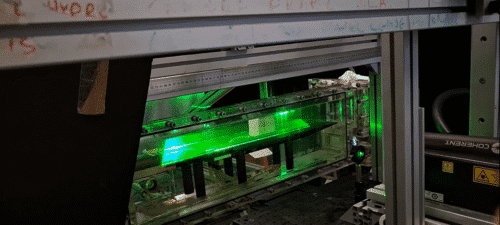
- Turbulent flow over a backward-facing step: high resolution velocity field
- Vortex flow: time-resolved velocity field and turbulent kinetic energy field
- Air (smoke) around a vibrating wing: high resolution velocity field
- Microfluidics in biological capillaries: high resolution velocity field
Scientific Publications
Peer-reviewed research and preprints co-authored by our team,
exploring fluid mechanics, optical-flow velocimetry and real-time flow diagnostics.
Rare-event detection in a backward-facing-step flow using live optical-flow velocimetry: Observation of an upstream jet burst
Rare and extreme events in turbulent flows play a critical role in transport, mixing, and transition, yet they are notoriously difficult to capture experimentally. Here we report, to our knowledge, the first direct experimental detection of an upstream-directed jet burst in a backward-facing-step (BFS) flow at Reℎ=2100, using long-duration live optical flow velocimetry (L-OFV). Continuous monitoring over 1.5 h enabled a data-driven definition of extremes as rare velocity probes excursions deep into the observed distribution’s tails; in practice, large negative events (𝑢:𝑍<−6, 𝑣:𝑍<−5 at (𝑥,𝑦)=(2ℎ,ℎ/2), where |𝑍|≫0 stands for large deviations from the mean value) triggered the live capture of surrounding velocity fields.
The recording is triggered when the probes surpass the defined threshold, using live analysis of the velocity fields. The detected event features a jetlike intrusion into the recirculation region initiated by the collapse of a merged Kelvin–Helmholtz vortex and sustained by counterrotating vortices and is accompanied with heavy-tailed probe statistics and simultaneous amplification of fluctuating kinetic energy and enstrophy. While a single event was recorded, underscoring its rarity, the results establish L-OFV as a viable platform for rare-event detection in separated shear layers and document a previously unreported mechanism of upstream jet bursting in BFS flow.
Authors
- Juan Pimienta, PhD in fluid mechanics at Photon Lines
- Jean-Luc Aider, Research Director at the CNRS within the PMMH laboratory at ESPCI
High Resolution and High-Speed Live Optical Flow Velocimetry
Particle Image Velocimetry (PIV) typically relies on cross-correlation,which makes it difficult to obtain instantaneous velocity fields that are both spatially dense and available in real time at high acquisition rates. Optical Flow Velocimetry (OFV) offers a per-pixel alternative. Here we demonstrate real-tome OFV that delivers dense velocity fields (one vector per pixel) with high effective spatial resolution at frequencies up to the kHz range. Using synthetic particle images for two benchmarks — a Rankine vortex and a homogeneous isotropic turbulence DNS — we show that, with suitable particle seeding, OFV can resolve strong displacement gradients down to small scales.
We then achieve real-time performance through algorithmic refinements and GPU-focused optimizations, combined with practical choices of OFV parameters. With this implementation, 21 Mp fields are processed live at 90 Hz, 4 Mp fields up to 460 Hz, and 1 Mp fields up to 1400 Hz. The method is further validated experimentally on the flow past a circular cylinder, where dense instantaneous velocity fields support real-time computation of derived quantities over long durations.
These capabilities enable in-experiment monitoring, recovery of low-frequency dynamics from sustained high-rate acquisition, and closed-loop-flow-control strategies based on OFV measurements while also accelerating conventional post-processing to reduce turnaround time and computational cost.
Authors
- Juan Pimienta, PhD in fluid mechanics at Photon Lines
- Jean-Luc Aider, Research Director at the CNRS within the PMMH laboratory at ESPCI
Videos